Showing posts with label Inspiration. Show all posts

Friday, January 15, 2016

Hard-hitting cartoons by R K Laxman

Nine hard-hitting cartoons by R.K. Laxman, who will be always remembered as fearless, honest and witty cartoonist, who touched lives of millions of Indians.
 
1) Anti-Hindi Agitation of Tamil Nadu in 1960s:

clip_image003
 
In the 1960s, Tamil Nadu was rocked by anti-Hindi agitations, which resulted in death of several innocent civilians by police firing. It is said that DMK, which is a major political party in Tamil Nadu, owes it’s rise to power due to these violent agitations. R.K. Laxman’s cartoon, which mocked the agitation was included in the NCERT text book in 2012, again caused controversy and tension.

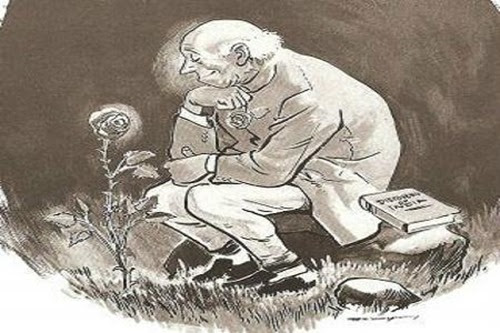
2) Jawaharlal Nehru during India China War of 1962

clip_image004
 
During the height of India-China war in 1962, R.K. Laxman drew this cartoon of PM Nehru, which actually was an observation on his decisions related with war, which India eventually lost. The caricature depicts the book “Discovery of India” and rose, which denotes love.
 
Shashi Tharoor, who recently wrote a tribute for R.K. Laxman shares an interesting story related with this cartoon. After the cartoon was published in Times of India, Nehru called him. His friends and relatives thought that he will get a scolding but instead of getting angry, Nehru said, “Mr. Laxman, I so enjoyed your cartoon this morning. Can I have a signed enlarged copy to frame?”

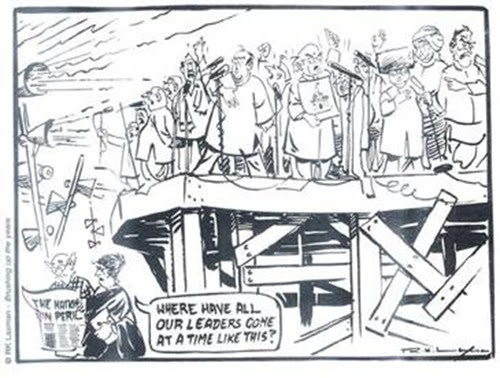
3) Religion and Politics of 1990s

clip_image006
In his book Brushing Up The Years, R.K. Laxman shares his cartoon, which depicts the state of the nation during 1990s, when people fought for building temples and destroying mosques. This cartoon was included in NCERT books, which again caused a storm of protests and agitations. Here, the common man is questioning Indian leaders; which is actually a mockery of politics.

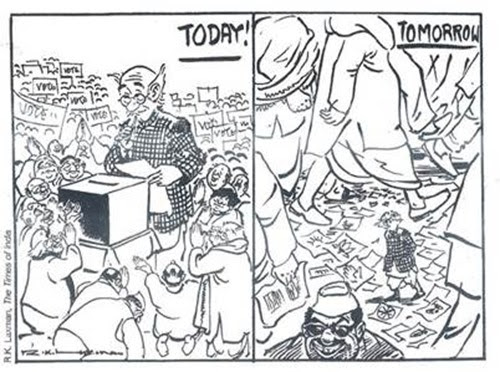
4) Elections and Promises

clip_image008
In this cartoon, Laxman shares the state of India, before and after elections. Although it was published in the 70s, the theme is still relevant. The apathy of the Common Man, who is promised heaven during the elections is totally ignored once the elections are over.

5) Indira Gandhi & Emergency

clip_image010
 
R.K. Laxman’s satire didn’t spare any politician, and that included Indira Gandhi, who imposed emergency in 1975. This cartoon depicts the state of the nation in 1980, the second elections after the Emergency ended in 1977. She managed to win, despite the negativity surrounding her.

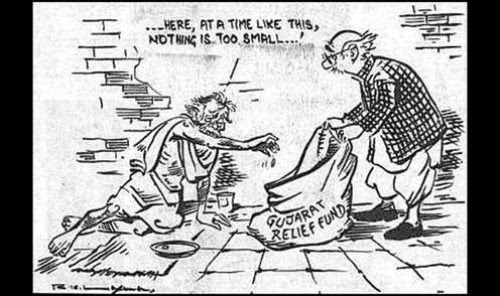
6) Gujarat Relief Funds and the Common Man

clip_image012
 
This cartoon showcases the unity and strength of India, after the devastating earthquakes which rattled Gujarat in 2001. The common man is being helped by a beggar for helping those who lost everything in Gujarat.

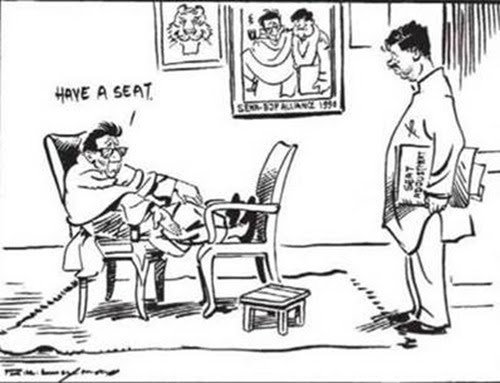
7) Shiv Sena & BJP In 1990

This cartoon published in 1990 highlighted the arrogance and ego of Bal Thackeray, before the elections, when he refused to join hands with BJP for maximum seats. It is strange how the tables have completely turned in Maharashtra now, as the exact opposite happened during last year’s election where BJP was at the commanding position.
 
Bal Thackeray was infact a close friend of Laxman, with whom he worked in several organizations.
 
clip_image014

8) Salman Khan Hit and Run case

clip_image016
 
Salman Khan’s car killed poor people who were sleeping on pavements; and the case is still pending. This cartoon was published right after this incident. Here, Laxman hasn’t mentioned anyone’s name, yet put across the thought in an amazing way. A classic example of his masterpiece.

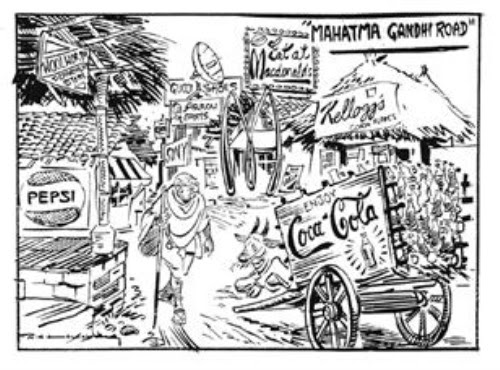
9) Mahatma Gandhi & Post Liberalization World

clip_image018
This insightful cartoon predicts what Mahatma would have seen, if he had come alive in India during the post-liberalization era during 1990s. It was the time when there was an intense opposition brewing up against multinational companies.

Monday, January 5, 2015

The immortal VANDE MAATARAM

BANKIM CHANDRA CHATTERJEE
and
HIS IMMORTAL POEM ‘VANDE MATARAM’ - I BOW TO MY MOTHER (MOTHER BHAARATAVARSHA)


Glorified by many as the last word in patriotic ardour, the song ‘Vande Mataram’ is not just a song but a symbol of the national culture of India. Even with a lapse of more than 130 years since its composition, it continues to hold an indelible place in the national psyche as is evident from its popularity even today. Sometime in 1992 when the B.B.C. London invited nominations for the most popular song in India, nearly 25,000 listeners of the BBC World Service nominated Vande Mataram as one of the most two popular songs. In 1915, M.K.Gandhi, not yet known as the Mahatma, spoke at a meeting in Madras which began with the singing of Vande Mataram for invocation. Addressing the huge gathering, Gandhiji said: “You have sung that beautiful national song on hearing which all of us sprang to our feet. The poet Bankim Chandra has lavished all the adjectives we possibly could do, to describe Mother India. It is for you and me to make good the claim that the poet has advanced on behalf of his Motherland”

Vande Mataram, which literally means “Mother! I bow to thee”, was the soul stirring slogan of the Indian freedom fighters during their struggle against the British regime .It forms part of a song which appears in a Bengali novel called ‘Anandamath’ published sometime in 1881 and written by the doyen of Bengali literature, Bankim Chandra Chatterjee [1838-1894]. Bankim Chandra was born in a village in Bengal in 1838. Even when he was studying in a high school in his village near Calcutta, his teachers were awed at his extraordinary intelligence and grasping power. Creating records at every step of his academic career, Bankim coveted the top honours in the Presidency College, Calcutta and was the first graduate of the Calcutta University along with his compatriot Jadunath Bose. In the year 1858 when he was 20 years old he became a Deputy Magistrate—the highest administrative position a contemporary Indian could have reached in those days under the British Government. In spite of the coveted position he held. Bankim’s real genius lay in Bengali literature. He wrote about 15 novels in Bengali like Durgesh Nandini, Kapala Kundala, Mrinalini, Visha Kanya etc but it was his novel Anandamath and the song in it , Vande Mataram, that brought him fame all over the country. Anandamath, before it came out in the form of a book, had been serialized in a Bengali literary journal called ‘Banga Desh’ edited by Bankim himself.

One day, sometime about 1875, Bankim was returning home in the evening by train from Calcutta where the office of ‘Bangadesh’ was located. Looking on either side of the window, he was enjoying nature in all its pristine glory. The sylvan beauties of the river, the brook, the chirping of birds, flora and fauna etc totally absorbed his attention. Even when he reached home, the pleasant thoughts continue to dominate his mind. The inherent literary genius in the man manifested itself when Bankim took out a piece of paper and jotted down these pleasant memories in the form of a poem, as and when they occurred to him. Some lines came out in his mother tongue Bengali while the others were in Sanskrit. These are the very lines which eventually became famous as ‘Vande Mataram’ and which found a place in his novel ‘Anandamath ‘at a much later date.

In the memoirs written by Bankim Chandra’s younger brother, it has been recounted that the poem had been lying around for several years in Bankim’s study. One of the assistants who helped Bankim in editing ‘Banga Desh’, one day picked up the poem and said “This is not so bad and will do quite well as a filler to fill up an empty space we have in the galley-proofs for the number”. It is learnt that Bankim refused to have it published in that fashion and said “You cannot possibly guess now if this is good or bad. Time will tell—I shall be dead by then. It is possible that you may see that day”. That was the end of the matter and the poem as we know remained unpublished till Bankim went back to the poem he had written many years ago to make it the centerpiece of a complete mosaic of ideas, the novel ‘Anandamath’. 

Sometime in 1881, Bankim’s novel was serialized in his own magazine ‘Bangadesh’. This novel contained the first few lines of ‘Vande Mataram’ which Bankim first composed and also included some additional lines. A notable fact was that when the poem was inserted in the journal, the first 12 lines constituting the first two poems were put within quotation marks while the rest of the poems namely lines 13 to 27 did not have any such quotation marks. It could therefore be inferred that the first twelve lines were those written earlier, sometime in 1875 and the others were written sometime later, probably in 1881, bearing in mind the theme of ‘Anandamath’. This distinction gains importance because it was the latter part which contained those "explicit" and "idolatrous" imageries which were objected to by many outside the Hindu community. It would be of interest to note that the central theme of Anandamath pertains to the determined struggle of a band of patriotic Sanyasis who fought against the oppressive rule of the East India Company and died in the battle with the cry of ‘Vande Mataram’ in their lips.

Vande Mataram remained dormant and did not get wide publicity or popularity for quite a few years after its publication in the magazine. However, in the year 1896 when the Indian National Congress held its Session in Calcutta, the Session started with the invocation of ‘Vande Mataram’ The singer was no other than Gurudev Ravindranath Tagore (Thakur) who set the tune to the song and sang it in the presence of a distinguished audience. When the song was over there was thunderous applause. Reacting to the popular response to ‘Vande Mataram’, Tagore observed sometime later:
“When I set the tune to the song and sang it before a vast assemblage of people in the Congress Session at Calcutta, I felt myself electrified from top to toe. It was not a song. It was molten fire. Every word and every line engulfed the audience with the fire of patriotism”. In a letter to Jawaharlal Nehru sometime later in 1937, Tagore writes “The privilege of originally setting its [Vande Mataram’s] first stanza to the tune was mine when the author was still alive and I was the first person to sing it before a gathering of the Calcutta Congress”. With the singing of Vande Mataram in Calcutta in 1896, it attained fame, popularity and publicity and also the importance which it deserved, all over the country. 

With the partition of Bengal in 1905 and the rise of the Swadeshi Movement all over the country fighting for independence, Vande Mataram got a terrible boost. Practically it became a Mantra on the lips of every patriotic Indian. The great Tamil poet Subramanya Bharathi translated into Tamil in 1905 and this was followed by several other translations in Marathi, Kannada, Telugu, Gujarati, and Malayalam etc – all between 1905 to 1908. The song was heard in public meetings and processions in many places across India. It was on the lips of every Bengali Swadeshi agitator during the partition of Bengal..

Another event which made the song popular was the Congress Session held in 1905 in Benares when it was sung as an invocation song. The President of the session, Sri. Gopalakrishna Gokhale, requested a Bengali lady by name Saraladevi Chodhurani to sing Vande Mataram before the commencement of the session. She was no other than Rabindranath Tagore’s niece. Commenting on Vande Mataram some time later, Mahatma Gandhi wrote in the ‘Indian Opinion’ dated 2nd December 1095 “The song has proved so popular that it has come to be our National Anthem. Just as we worship our mother, so is this song a passionate prayer to India” 

The tradition of singing Vande Mataram in the Congress Sessions continued till 1930 when some Muslims objected to the singing of the same. When the Congress came to power in six of the eleven provinces in 1937, the song acquired the status of a National Anthem to which the Muslim League protested vehemently, describing it as ‘anti-national and "idolatrous" in its inspiration and ideas’. With a view to accommodating the feelings of the Muslims, the Congress Working Committee met in October 1937 and passed the following resolution:

“The Committee recognise the validity of the objection raised by Muslim friends to certain parts of the song. While the Committee have taken note of such objection in so far as it has intrinsic value, the Committee wish to point out that the modern evolution of the use of the song as part of national life is of infinitely greater importance than its setting in a historical novel before the national movement had taken shape. Taking all things into consideration the Committee recommend that wherever the Vande Mataram is sung at national gatherings, only the first two songs should be sung, with perfect freedom to the organizers to sing any other song of an unobjectionable character, in addition to, or in place of, the Vande Mataram song”.

The Congress resolution, widely perceived as a concession, did not satisfy the Muslim League who wanted the deletion of Vandemataram in toto. Mahatma Gandhi was unwilling to allow the song to be a pawn in politics. In July 1939, Gandhiji published an essay about this in his ‘Harijan’dated 1st July 1939 where he recalled that ‘Vande Mataram was a powerful battle cry and that he himself as a lad was enthralled by the song’. He went on to say: “It never occurred to me that it was a Hindu song nor meant only for Hindus. Unfortunately now we have fallen on evil days. All that was pure gold has become base metal today. In such times it is wisdom not to market pure gold and let it be sold as base metal. I would not risk a simple quarrel over singing Vande Mataram at a mixed gathering. It will never suffer from disuse. It is enthroned in the hearts of millions”

Describing the significance of the song Vande Mataram, Maharshi Aurobindo said sometime in 1907 “ It was 32 years ago that Bankim wrote his great song and few listened : but in a sudden moment of awakening from long delusions the people of Bengal looked around for the truth and in a fated moment somebody sang ‘Vande Mataram’. The mantra had been given and in a single day a whole people had been converted to the religion of patriotism. The Mother had revealed herself. Once that vision has come to the people, there can be no rest, no peace, no further slumber till the temple has been made ready, the image installed and the offering offered. A great nation which has had that vision can never again bend its neck in subjection to the yoke of a conqueror” 

About 30 years later, some time in November 1938, Sri Aurobindo had a fracture in his thigh and many of his close disciples used to go to the Ashram and spend some time with him in the evening to get the benefit of his advice on some of their doubts on varied subjects. One such disciple met him at the Ashram on 30th December 1939 and raised the problem of the Muslims’ objection to the singing of Vandemataram. The dialogue went on like this:

Disciple: Sir, there are some people who object to ‘Vande Mataram’ as a national song. And some congressmen support the removal of some parts of the song.

Maharshi: In that case the Hindus should give up their culture.

Disciple: The argument is that the song speaks of Hindu goddesses like Durga (a powerful and potent version of the domestic Mother Goddess Parvati, coomonly worshipped by Hindu men to bestow upon us, her formidable, indomitable power and strength who has a thousand tools in her arms to protect and avenge harm done to her children) and that is offensive to Muslims

Maharshi: But it is not a religious song. It is a national song and the Durga spoken of is India as the Mother. Why should not the Muslims accept it? It is an image used in poetry. In the Indian concept of nationality, the Hindu view would naturally be there. If it cannot find a place here, the Hindus may as well be asked to give up their culture. The Hindus don’t object to ‘Allah-ho-Akbar. Why should not the Hindu worship his God? Otherwise, the Hindus must either accept Mohammedanism or the European culture or become atheists. I told C.R. Das in 1923 that this Hindu-Muslim question must be solved before the Britishers go as otherwise there was a danger of civil war. He also agreed and wanted to solve it. 

The Vande Mataram controversy was finally resolved on the final day of the Constituent assembly on January 24th 1950 when Rajendra Prasad, the President of the Assembly, ruled from the chair that whereas Jana-gana-mana (a different song) would be the National Anthem, Vande Mataram “shall be honoured equally” and “shall have equal status “with the National Anthem. It is significant that there was neither a discussion nor a vote on the subject. This lends credence to the suggestion that a free vote would probably have led to the founding fathers enshrining Vande Mataram as the National Anthem.

B. M. N. Murthy

Wednesday, December 24, 2014

Major loss, a veteran passes away !

Video on KB

மறைந்த கே.பி. அவர்கள் தான் இயக்கிய திரைப்படங்களின் கதை நாயகிகள் குறித்து அவள் விகடனுக்கு கடைசியாக அளித்த சிறப்பு பேட்டி கட்டுரை
'என் கதைநாயகிகள் ஒவ்வொருவரையும் கதைக்காக நான் உருவாக்கியிருந்தாலும், அவர்கள் அனைவரும் அழுத்தமான சிந்தனைகளை சமூகத்தில் பதித்தவர்கள்.

'அச்சமில்லை அச்சமில்லை’ - 'தேன்மொழி’, என் மரியாதைக்குரியவள். அச்சம், கோபம், வெறுப்பு, ஆக்ரோஷம் என்று 'தேன்மொழியி’ன் அத்தனை உணர்ச்சிகளையும் திரையில் கொண்டுவந்தவர், சரிதா.

தேன்மொழி, தைரியமான பெண். நேர்மையும், சத்தியமும் முக்கியம் என்று நினைப்பவள். அப்படி ஒருவனான 'உலகநாதனை’ (ராஜேஷ்) விரும்பி திருமணம் செய்துகொள்வாள். காலப்போக்கில் கட்சியில் வளரும் அவன், கொஞ்சம் கொஞ்சமாக தன் சுயத்தை இழந்து, நேர்மையில்லாதவனாக மாறிவிடுவான். இதைத் தாங்க இயலாதவளாக கணவனை கண்டித்துக்கொண்டே இருப்பாள்.


ஒரு கட்டத்தில் கணவன் செய்யும் அட்டூழியங்கள் எல்லை மீற, 'உம்மட அழகப் பாத்தும் உம்மட பல்லு வரிசையைப் பாத்தும் கட்டிக்கிறலைய்யா... உம்மட சொல்லுக்கும் உண்மைக்கும்தான் உமக்கு பொஞ்சாதியா ஆனேன்யா...’ என்பாள். 'பொஞ்சாதிங்கிறவ அடுப்பங்கறையிலதான் இருக்கோணும். இன்னும் பச்சையா சொல்லணும்னா, நான் படுன்னா படுக்கணும்’ என்பான். இறுதியாக கணவனைப் பிரிந்துவிடுவாள் தேன்மொழி. அதன் பிறகும் அவனுடைய அட்டூழியங்கள் தொடரும். ஒரு விழாவில், கணவனுக்கு மேடையில் மாலை போட்டு, மாலைக்குள் மறைத்து வைத்திருந்த கத்தியால் அவனைக் குத்தி கொலை செய்துவிட்டு ஜெயிலுக்குப் போவாள். படத்தின் கடைசிக் காட்சியில் காந்தி சிலைக்கு கீழ் 'சுதந்திரம்’ என்ற பெயர் கொண்ட ஒருவன் அழுதுகொண்டிருப்பான். 'சுதந்திரம் அழுதுகொண்டிருக்கிறது’ என்று படத்தை முடித்திருப்பேன்.

கணவனாகவே இருந்தாலும், அவனால் பிறர் பாதிக்கப்படக் கூடாது என முடிவெடுத்து அந்தக் குற்றவாளியைக் களையெடுக்கும் தேன்மொழி, நேர்மைக்கும் துணிவுக்கும் முன்னோடி. இன்று பெண் பிள்ளைகளுக்கான பாதுகாப்புக்கு, ஆண் பிள்ளைகளை வீட்டில் கண்டித்து வளர்க்க வேண்டியது பற்றி வலியுறுத்தப்படுகிறது. அதைத்தான் அன்றே சொன்னாள் என் 'தேன்மொழி’!


'அரங்கேற்றம்’ படத்தின் நாயகி 'லலிதா’, என்னால் மறக்க முடியாதவள். லலிதா பாத்திரத்தை பிரமீளா, ஏற்றிருப்பார். 'நாம் இருவர் நமக்கு இருவர்’ என்கிற பிரசாரத்தை அரசாங்கம் முன்வைத்த தருணத்தில் எடுத்த இப்படத்தில், அதிகப் பிள்ளைகள் பெறும் குடும்பங்கள் படும்பாட்டை முன்வைத்திருப்பேன். ஒரு பிராமண புரோகிதருக்கு 8 பிள்ளைகள். லலிதா, மூத்தவள். அடுத்த தம்பி, கமல்ஹாசன். குடும்பத்தின் பசியைக்கூட முழுமையாக போக்க இயலாத புரோகிதரின் பிள்ளைகளுக்கு டாக்டராக வேண்டும், பாடகியாக வேண்டும் என்று ஒவ்வொருவருக்கும் ஒவ்வொரு கனவு. தம்பி, தங்கைகளின் ஆசைகளை நிறைவேற்றத் தவிப்பாள் லலிதா. தம்பிக்கு மருத்துவக் கல்லூரியில் இடம் வாங்கித் தருவதற்காக சென்னைக்கு வருபவள், அரசியல்வாதி ஒருவனின் காமப்பசிக்கு பலியாகிவிடுவாள். நியாயம் கேட்க முடியாமல் அழுது தீர்த்து, ஒருவழியாக போராடி தம்பிக்கு இடம் வாங்கித் தந்துவிடுவாள். ஆனால், வீட்டினரை சந்திக்கும் தைரியம் இல்லாதவளாக, ஹைதராபாத்தில் வேலை கிடைத்துவிட்டதாகச் சொல்லி, குடும்பத்தைப் பிரிவாள்.

'இனி, இந்த உடல் எனக்குத் தேவையில்லை’ என்பவள், ஒரு கட்டத்தில் விலை மாது என்று மாறி நிற்பாள். முன்பு தான் காதலித்த 'தங்கவேலு’ (சிவகுமார்) எதிர்பாராதவிதமாக, இவள் இருக்கும் இடத்துக்கு வந்து அதிர்ச்சியில் உறைந்து நிற்பான். ''இது தப்புனு தெரியும். ஆனா, நீயும் என்னைத்தானே விலை பேச வந்திருக்கே?'' என்று லலிதா கேட்க, கூனிப்போவான் தங்கவேலு.

இடையில் தங்கையின் திருமணத்துக்காக வீட்டுக்கு வரும் லலிதா, அவள் அம்மா நிறைமாத கர்ப்பிணியாக இருப்பதைக் கண்டு அதிர்ச்சியாவாள். கோபம் வந்தவளாய் சுவரில் வரைந்த முக்கோண சின்னத்தை காட்டும் இடத்தில், சமூகத்துக்குப் பாடம் சொல்லும் லலிதா, அந்த விழிப்பு உணர்வு இல்லாததால்தான் தனக்கு இந்நிலை என்பதை பரிதாபமாக உணர்த்துவாள். தன் மாராப்பு விலகியதைக்கூட கவனிக்காமல் இருப்பவளிடம், தங்கை அதை சுட்டிக்காட்ட, 'ஆம்பளை என்பதே மரத்துப் போச்சு!’ என்பாள். உண்மை எல்லோருக்கும் தெரிய வரும்போது வாய்க்கு வந்தபடி பேசி விரட்டி அடிப்பார்கள். தங்கவேலு அவளைத் திருமணம் செய்துகொள்ள, அவளுக்கு கொஞ்சம் கொஞ்சமாக மனநிலை பாதிக்கப்பட்டு, கடைசியாக கடலை நோக்கி ஓடுவாள்.

சூழ்நிலையாலும் சமூகத்தாலும் அணைந்துபோன மெழுகுவத்தியாக இருந்தாலும், நாம் வாழும் சமூகம் குறித்து நம்மை யோசிக்க வைத்தவள் லலிதா.

நான் நேசிக்கும் சமகாலத்து கதாபாத்திரம், 'கல்கி’. இதில் ஸ்ருதி நடித்திருப்பார். தன்னைத் தானே செதுக்கிக்கொள்வது போல் படத்தில் வரும் சிலைதான், 'கல்கி’யின் இயல்பும். தான் சிந்திப்பதுதான் சரி என்று நினைப்பவள். அதேநேரத்தில், அவள் சிந்தனை புதுமையானதாகவும் தைரியமானதாகவும் இருக்கும். கற்பு என்பது உடம்பு சம்பந்தப்பட்டது அல்ல... மனதில் இருப்பது என்பாள். இப்போது பரவலாக இருக்கும் ரெடிமேடு இட்லி மாவு தொழிலை அப்போதே அறிமுகப்படுத்திய அறிவுக்குரியவள்.

படத்தில் நடித்த கீதா, ரேணுகா என்று இரண்டு பெண்களைத் திருமணம் செய்து கொள்ளும் 'பிரகாஷ்' (பிரகாஷ்ராஜ்), இரு வரையுமே கொடுமைப்படுத்துவான். கீதாவுக்கு குழந்தையில்லாத குறையை மனதில் வைத்து, பிரகாஷை திருமணம் செய்துகொள்ளும் கல்கி, அவன் பாணியிலேயே அவனை பாடாய்ப் படுத்துவாள். அவனால் கர்ப்பமாகி குழந்தையை யும் பெற்று, கீதாவிடம் தருவாள். குழந்தை பெற்றுக்கொள்ள முடியாத ஒரு பெண்ணுக்கு, இன்னொரு பெண் எப்படி வாடகைத் தாயாக இருக்கிறாளோ, கிட்டத்தட்ட அதேமாதிரிதான் கல்கியும் தன் செயலால் நிரூபித்திருப்பாள். ஏற் கெனவே கல்கியைக் காதலித்த ரஹ்மான், அவள் ஒருவனுக்கு மனைவியாகி, ஒரு குழந்தைக்குத் தாயாகி திரும்பிவரும்போதும் புரிந்துகொண்டு முழுமையாக ஏற்றுக்கொள்ளும் நேசமுடைய பாத்திரம். முற்போக்கு சிந்தனைகள் குறைவாக இருந்த காலத்தில் வந்த படம். சமூகக் கட்டுப் பாடு அவசியம்தான். அதேநேரத்தில் தனிமனித சுதந்திரம் தேவையானதும்கூட. கல்கி, சமூகத் துக்கு புதிய சாட்டையடி தந்தவள். நான் எடுத்த படங்களை 'பார்ட் 2’ எடுக்கச் சொன் னால், 'கல்கி’தான் என் சாய்ஸ்!

எந்நாளும் பெண்மையின் அறிவையும், துணிவையுமே பேசுபவர்கள்தான் என் கதைநாயகிகள்!''
==========
A true fan's statement below: (not mine, but I agree with this since I was also born in 1960, around the same time.)
இயக்குநர் சிகரம் கே.பாலச்சந்தர்... என்னுடைய 9 வயதிலிருந்து என் உள்ளத்தில் வாழ்ந்து கொண்டிருக்கும் பெயர் இது. 1965 ஆம் ஆண்டு. அந்த ஆண்டில்தான் பாலச்சந்தர் படவுலகிற்குள் காலடி எடுத்து வைக்கிறார். எம்.ஜி.ஆர்.நடித்த 'தெய்வத்தாய்' படத்திற்கு அவர் வசனம். தொடர்ந்து அவர் எழுதிய வெற்றி பெற்ற நாடகமான 'சர்வர் சுந்தரம்' திரைப்பட வடிவமெடுத்தது. ஏவி.எம்.தயாரித்த அந்தப் படத்தை இயக்கியவர்கள் கிருஷ்ணன்-பஞ்சு. நாகேஷை சிம்மாசனம் போட்டு உட்கார வைத்த படமது. அந்த ஆண்டிலேயே பாலச்சந்தர் இயக்குநர் அவதாரம் எடுக்கிறார். அவர் இயக்கிய முதல் படம் 'நீர்க்குமிழி'. நாகேஷ் நடித்த படம். முழு படமும் ஒரு மருத்துவமனையிலேயே படமாக்கப்பட்டது. அதில் இடம் பெற்ற 'ஆடி அடங்கும் வாழ்க்கையடா' என்ற பாடலை நம்மால் மறக்க முடியுமா? முதல் படத்திலேயே 'யார் இந்த பாலச்சந்தர்?' என்று கேட்க வைத்தார். அடுத்து அவர் இயக்கிய படம் 'நாணல்'.சிறையிலிருந்து தப்பித்து வரும் கைதிகள் ஒரு வீட்டிற்குள் நுழைந்து, அங்கு இருப்பவர்களை மிரட்டும் கதை. முழுப் படமும் ஒரு வீட்டிலேயே. அருமையாக இயக்கியிருந்தார் பாலச்சந்தர். தொடர்ந்து அவரின் இயக்கத்தில் வெளியான படம் 'மேஜர் சந்திரகாந்த்'. படத்தின் கதாநாயகி ஜெயலலிதா. அவரின் அண்ணனாக நாகேஷ். முத்திரை பதிக்கும் பாத்திரத்தில் சுந்தர்ராஜன். மிகச் சிறந்த படமாக அதை பாலச்சந்தர் இயக்கியிருந்தார். அதில் இடம் பெற்ற 'கல்யாண சாப்பாடு போடவா,' 'ஒருநாள் யாரோ' ஆகிய பாடல்கள் காலத்தைக் கடந்து வாழ்ந்து கொண்டிருக்கின்றனவே! முழு நீள நகைச்சுவைப் படமாகவும், நல்ல ஒரு குடும்பக் கதையாகவும் கே.பி. இயக்கிய படம் 'பாமா விஜயம்'. மக்களின் வரவேற்பைப் பெற்று நன்றாக ஓடிய படம அது. 'வரவு எட்டணா செலவு பத்தணா'வை எப்படி மறக்க முடியும்? அவர் இயக்கி ஓடிய இன்னொரு படம் 'நவக்கிரகம்'. பாலச்சந்தருக்கு மரியாதையைப் பெற்றுத் தந்த படம்'எதிர் நீச்சல்'. மாடிப்படி மாதுவையும், அடுத்தாத்து அம்புஜத்தையும், இருமல் தாத்தாவையும் நாம் எப்படி மறப்போம்? 'தாமரை கன்னங்கள்' பாடலை அந்தக் காலத்திலேயே என்ன அருமையாக படம் பிடித்திருப்பார் கே.பி.! அவர் இயக்கி இப்போதும் அனைவரின் மனங்களிலும் வாழ்ந்து கொண்டிருக்கும் படம் 'இரு கோடுகள்'. சவுகார் ஜானகி 'அச்சா' என்று உச்சரிக்கும் அழகையும், கூடைக்குள் குழந்தையைத் தேடும் நாகேஷையும், பாப்பா பாட்டு பாடிய பாரதி, புன்னகை மன்னன் பூவிழி கண்ணன் பாடல்களையும் நாம் மறக்க முடியுமா? முற்றிலும் மாறுபட்ட கதையுடன் பாலச்சந்தர் இயக்கிய படம் 'புன்னகை'. காந்திய கொள்கைப்படி நேர்மையாக வாழ முடியுமா, முடியாதா? இதுதான் அப்படத்தின் கதை. நாகேஷ் 'நானும் கூட ராஜாதானே நாட்டு மக்களிலே' என்று பாடிக் கொண்டு புகைவண்டி நிலையத்தில் பிச்சை எடுப்பார். ஜெமினி கணேசன் உண்மை மட்டுமே பேசி, வறுமையில் உழன்று சாவார். பொய் பேசியவர்கள் எல்லோரும் வசதியாக இருப்பார்கள். இன்று அதுதானே நடக்கிறது! ஜெய்சங்கர் நடிக்க கே.பி.இயக்கிய படம் 'நூற்றுக்கு நூறு'. கவர்ச்சி நடனம் ஆடிக் கொண்டிருந்த விஜயலலிதாவிற்கு அருமையான கதாபாத்திரத்தைக் கொடுத்திருந்தார் பாலச்சந்தர். 'உன்னை வாழ்த்திப் பாடுகிறேன்' பாடல் நம் செவிகளில் எந்நாளும் முழங்குமே! நடிகர் திலகம் சிவாஜி கணேசனை வைத்து ஒரே ஒரு படத்தை இயக்கினார் கே.பி. படத்தின் பெயர் 'எதிரொலி'. அருமையான கதை. ஆனால்,படம் ஓடவில்லை. பாலச்சந்தர் இயக்கி, பரபரப்பாக பேசப்பட்ட படம் 'அரங்கேற்றம்'. குடும்பத்தைக் காப்பாற்றுவதற்காக விலைமாதுவாக மாறும் ஒரு இளம் பெண்ணின் கதை. பிரமீளா கதாபாத்திரமாகவே வாழ்ந்திருந்தார். அவரின் தம்பியாக கமல். 'மூத்தவள் நீ இருக்க' என்ற பாடல் இப்போதும் என் செவிகளில் ஒலித்துக் கொண்டிருக்கிறது. 'அவள் ஒரு தொடர்கதை' காலத்தைக் கடந்து வாழும் கே.பி.யின் படமிது. சுஜாதாவின் உயர்ந்த நடிப்பைக் கொண்ட படம். கடவுள் அமைத்து வைத்த மேடை, தெய்வம் தந்த வீடு வீதியிருக்க ஆகிய பாடல்கள் அப்படத்தின் பெருமையைக் கூறிக் கொண்டேயிருக்குமே! கமலையும், கவிதாவாக நடித்த சுஜாதாவையும், அவரின் அண்ணனாக அறிமுகமான ஜெய்கணேஷையும், 'என்னடி உலகம்' பாடிய ஃபடாபட் ஜெயலட்சுமியையும் நாம் மறப்போமா? சவுகார் ஜானகியின் சொந்தப் படம் 'காவியத் தலைவி'. அதை இயக்கியவர் பாலச்சந்தர். தாய்,மகள் இரட்டை வேடங்களில் வாழ்ந்திருந்தார் ஜானகி. 'கண்ணா சுகமா கிருஷ்ணா சுகமா?' என்ற பாடலைக் கேட்கும்போதெல்லாம் சவுகாரின் மிகச் சிறந்த நடிப்பும்,கே.பி.யின் இயக்கமும் நம் ஞாபகக்தில் வரும். ஜெமினி கணேசனின் 100 ஆவது படம் 'நான் அவனில்லை'. அதை இயக்கியவர் பாலச்சந்தர். என்ன மாறுபட்ட கதை! கே.பி.இயக்கிய அருமையான படம் 'சொல்லத்தான் நினைக்கிறேன்'. 'இதயம் பேசுகிறது' மணியனின் கதை. கதாநாயகன் சிவகுமார். ஜெயசித்ராவின் 'டொன்டொடெயின்' வசனம் இப்போதும் கேட்டுக் கொண்டேயிருக்கிறதே! அதில் வில்லனாக நடித்த கமலை கதாநாயகனாக்கி கே.பி. இயக்கிய படம் 'மன்மத லீலை'. அதுவும் ஒரு வெற்றிப் படமே. பாலச்சந்தர் இயக்கிய இன்னொரு படம் 'பூவா தலையா' மதுரையில் பறந்த மீன் கொடியை, குற்றால அருவியிலே பாடல்களை நம்மால் மறக்க முடியுமா? யாரும் நினைத்துப் பார்க்க முடியாத கதை 'அபூர்வ ராகங்கள்'. கமல் நடித்த அந்தப் படத்தில்தான் ரஜினியின் பிரவேசம்! படம் முழுக்க பாலச்சந்தரின் முத்திரை. கமல், ரஜினி இருவரையும் வைத்து கே.பி.பண்ணிய கனமான கதை 'மூன்று முடிச்சு'. என்ன பண்பட்ட இயக்கம்! அவரின் இன்னொரு குறிப்பிடத்தக்க படம் 'நிழல் நிஜமாகிறது'. ஷோபா என்ன இயல்பாக நடித்திருப்பார்! ரஜினி, கமல், சுஜாதா மூவரும் நடிப்பில் முத்திரை பதிக்க, பாலச்சந்தர் இயக்கிய படம் 'அவர்கள்'. மலையாளம் கலந்த தமிழ் பேசிய கமலும், அவரின் பொம்மையும் மனதிலேயே நிற்கிறார்களே! கே.பி.யின் இன்னொரு மறக்க முடியாத படம் 'நினைத்தாலே இனிக்கும்'. ரஜினி,சரிதா இருவரின் அருமையான நடிப்பைக் கொண்ட படம் 'தப்புத் தாளங்கள்'. 'அட என்னடா பொல்லாத வாழ்க்கை' என்ற ஒரு பாடலே படத்தின் கதையைக் கூறி விடுமே! கே.பி.யின் திறமையை படம் முழுக்க நாம் பார்க்கலாம். 'நூல்வேலி'- பாலச்சந்தரின் திறமையை வெளிப்படுத்திய இன்னொரு படம்.அவர் இயக்கிய மாறுபட்ட படம் '47நாட்கள்'. சிவசங்கரியின் கதை. சிரஞ்சீவி வில்லத்தனமான ஹீரோ. தெலுங்கில் பாலச்சந்தர் இயக்கி, மிகப் பெரிய வெற்றியைப் பெற்ற படம் 'மரோ சரித்ரா'. கமலும், சரிதாவும் காதலர்களாக வாழ்ந்திருப்பார்கள்! தெலுங்கில் கே.பி.இயக்கிய இன்னொரு அருமையான படம் 'கோகிலம்மா'. கதாநாயகன் ராஜீவ். கேட்கும் சக்தி இல்லாத பெண்ணாக சரிதா! இப்போது கூட அந்த கதாபாத்திரம் என் உள்ளத்தில் வாழ்ந்து கொண்டிருக்கிறது. கோமல் சுவாமிநாதன் நாடகமாக நடத்தி வெற்றி பெற்ற கதை 'தண்ணீர் தண்ணீர்'. அதை நல்ல ஒரு படமாக இயக்கிய பாலச்சந்தரை நாம் நிச்சயம் பாராட்ட வேண்டும். அடுத்து அவர் இயக்கிய அச்சமில்லை அச்சமில்லை, அக்னிசாட்சி இரண்டுமே கே.பி.யின் முத்திரைப் படங்கள்தாம். வேலை இல்லா திண்டாட்டத்தை மையமாக வைத்து எடுக்கப்பட்ட 'வறுமையின் நிறம் சிவப்பு'... ஒரு நர்ஸின் போராட்ட வாழ்க்கையை வெளிப்படுத்திய 'மனதில் உறுதி வேண்டும்'...கலகலப்பான 'தில்லு முல்லு', 'பொய்க்கால் குதிரை'...மக்களிடம் பெரிய வரவேற்பைப் பெற்ற 'சிந்து பைரவி', ஆணின் உதவியே இல்லாமல் பெண்ணால் வாழ முடியும் என்பதைக் கூறிய 'கல்யாண அகதிகள்', முற்பாதியில் ஒரு கதையும்,பிற்பாதியில் இன்னொரு கதையும் என்று எடுக்கப்பட்ட 'ஒரு வீடு இரு வாசல்', இளமை தவழும் 'புன்னகை மன்னன்', தன்னம்பிக்கையூட்டும் 'உன்னால் முடியும் தம்பி', வித்தியாசமான கதைக்கருவைக் கொண்ட 'புதுப்புது அர்த்தங்கள்', தனித்துவம் நிறைந்த 'கல்கி', குஷ்புவை வைத்து இயக்கிய 'ஜாதிமல்லி', மறக்க முடியாத 'டூயட்', இளைஞர்களுக்கு வழி காட்டிய 'வானமே எல்லை', இந்தியில் இயக்கி சாதனை புரிந்த ஏக் துஜே கே லியே, ஏக் நயீ பஹேலி... அவர் இயக்கிய ரயில் சிநேகம் உள்ளிட்ட தொடர்கள்... இப்படி கே.பி.என்ற கே.பாலச்சந்தரின் சாதனைகளையும், பெருமைகளையும் இப்படி கூறிக் கொண்டே போகலாம். அரைக்கால் சட்டை அணிந்த சிறுவனாக இருந்த காலத்திலிருந்தே நான் அவரின் வெறித்தனமான ரசிகன். அவரின் பெயர் திரையில் வரும்போது உணர்ச்சி வசப்பட்டு கைதட்டியவன். இப்போதும் நான் அவரின் ரசிகனே. தமிழ் திரைப்படவுலகிற்கு கிடைத்த அரிய பொக்கிஷம் அவர். கலையை நேசிப்பவர்களுக்கு அவர் ஒரு கலங்கரை விளக்கம். இந்தியப் படவுலகில் தமிழ்ப் படவுலகிற்கு மரியாதையையும், மதிப்பையும் எப்போதோ வாங்கிக் கொடுத்தவர். காலத்தைக் கடந்து நிற்கும் ஒப்பற்ற திறமைசாலி. படவுலக வரலாற்றில் 'கே.பாலச்சந்தர்' என்ற பெயர் பொன்னெழுத்துக்களால் என்றும் பொறிக்கப்பட்டிருக்கும். அதுதான் 'இயக்குநர் சிகர'த்தின் யாரும் நெருங்க முடியாத சாதனை! இனி வரும் காலமும், புதிய தலைமுறையும் அவரின் பெருமையை பேசிக் கொண்டேயிருக்கும். அது மட்டும் நிச்சயம்!

Thursday, July 31, 2014

JRD

JRD Tata (also fondly known as Jeh) is well known for many achievements but to him was being Pilot No 1 of India.
An interesting ​
​story of his fascinating first flight to England as well as its re-creation later.
He was also very humble. I have read an incident narrated by a person in a magazine about him long ago. JRD ferried this person during  heavy monsoon rains in Mumbai and dropped him at VT station much away in the opposite direction to ensure "our " person will travel in comfort since VT was the starting point . All through the journey the person bragged about him and his social achievements and JRD listened to him intently.
At the point of alighting, the person asked just out of courtesy driver's name (see, it was after office hours and JRD was driving on his own !) to which JRD Tata replied "People call me JRD" and simply drove off !

'An Ethical life,is part of an Economic Lfe"Jeh ,the great!‘An Ethical life,is part of an Economic L
​i​
fe”
​ ​
 J​eh ,the great!

JRD Tata’s passion as an youngster of 15 when he flew with Louis Bleriot,was always to become an acePilot.When Charles Landberg made his pioneer Trans Atlantic flight,JRD made his own ink drawing of the ‘Spirit of St.Louis,Landberg’s Plane and copied a poem in French by Maurice Rostand in his red Scrapbook.

When Sir Victor Sassoon opened the First Flying Club in 1928,JRD immediately signed for taking training under a Trainer,E.D.Cummings and he signed the first recipt of his first Pilot’s Logbook on 22nd Jan1929!After 3Hrs45 mts of dual flying on Feb3rd he went on a solo!
​ ​
His diary says:
Feb3rd1929..Time in Air,15 Mts.
Pilot..Self.
Remarks…Ist Solo!
.India's Pilot Licence No 1.India’s Pilot Licence No 1
One can imagine the real passion in JRD when he gets an envelope with a blue card with Golden letters,an viator’s Certificate issued by Royal Aero Club of India and Burma on behalf of the Aeronautique Internationale (FAI)signed by Victor Sassoon,in his capacity as Chairman.It bore the NO 1(see pic)being the First Indian to get this Pilot Licence!

This passion is so immeasurable and later on we will see how JRD’s passion is single handedly killed by  Nehru!
JD writes in his diary “No document has ever given me greater thrill than this blue card with Gold letters,deliverd on 10th Feb1929.The fact that it bore the NO 1 added to my pride in owning it,even tho’ it meant nothing except that I was the First Indian to be qualified!”
Jeh's sistersJeh’s sisters
Jeh's sisters n brothersJeh’s sisters n brothers
Sooni and Ratanji Dadabhoy Tata,Jeh's ParentsSooni and Ratanji Dadabhoy Tata,Jeh’s Parents
It is pertinent to note here that his elder sister,Sylla,was the First Indian woman to get this Licence later,his younger sister,Rodabeh ,being the IInd woman .His younger brother Jimmy was prolific as a Pilot,and to the shock of JRD he gets killed in an Austrian Flying daredevilry!JRD’s passion to be learning all intricate mechanical details was so immense that he used to keep all his tools even in the late 90s in an organised manner in his Bungalow(see pic).Once when he was bedridden with a fracture,he needed a particular spanner,he directed his friend, “Second Shelf,third item from th Right!”..
Jeh's Tool RoomJeh’s Tool Room
A Man of meticulous planning and execution!

By March 1929 he had flown in excess of 20 Hrs and he wanted to buy his own plane,a Gypsy Moth from De Havilland for 1200 Pounds(Sir Geoffery of De Havilland was so obsessed with animals and moths,he named all his plane as Moths!)By now he had obtained the A licence and was frequently flying between Croydon,London to France with family and friends.Unfortunately when he took possession of his own plane ,he fell ill at Naples and cdn’t fly his own plane o Bombay.He sailed in Victoria with his plane to reach Bombay!

JRD was flying from Mumbai to Nagpur,and all other places but was always was, meticulous to keep all the imp instruments like Compass etc., well maintained.JRD was not happy with an Engineer,Major Vatch,who was not keeping the attention he ought to have given for the compass,tho’ he was a superb instructor!
JRD and Man Mohan Singh!
On Nov 1929,there was an ad in Times,London,announcing Aga Khan had offered a prize of 500 Pound Sterling,for the First Indian to fly solo between England and India,starting at either end.The conditions were:
1.Flight must be Solo.
2.Must be completed within 6 weeks from the D

​ate of starting 
​ ​3.Prize Open for One Year from 1st Jan 1930!


Among the competitors was an young Sikh called Man Mohan Singh!
He ,acc to Mr.Grey,an English critic in Aviation Journal ,was very highly enthusiastic that he made 3 attempts from Coydon but cdn’t proceed beyond Europe and returned to London.His plane was named as Miss India and Grey wrote in the journal
“He has named the plane Miss India and he is likely to do so!”

JRD quotes in his biography that Grey was cryptic and some of his comments are to be remembered for ever,like this one at that time, when Planes were carrying Mails :
“Mails may be lost,but never delayed!Passengers may be delayed but never lost!”
(
​GS : Sorry to see the plight of MH370) 

Jeh's First MothJeh’s First Moth
First Flight 1932First Flight 1932
Aspy Engineer:
Another competitor was Apy Engineer,18 Yr old ..
He also had a co-pilot Chawla,tho’ it was not allowed!They completed the flight from London to Bombay in 4 weeks and got a consolation prize from the Dir Civil Aviation!
The Third participant was JRD Tata..

All others were flying from London to Bombay but JRD was flying from Bombay to London,which acc to experts was much tougher due to wind speed etc.,
On May 1st 1930,JRD took off from Juhu to Karachi,where from the Aga Khan Prize race was to start.JRD had planned so well that he had asked the instructor King to check thCompass and all Map and other details.Theflight path was a closely held secret except his Two sisters and Jal Naoroji,his colleague,who was supposed to be in touch with JRD all thro the Race.
On 3rd May JRD took off from Karachi and via Gawdar stopped at Jask.He spent the first night at th Rep of Burmah Shell Representative..From Jask he flew to Hormuz,Lingeh,Bushire,and Basra.JRD departed from Rutbah on 6th May and he shd have been crossing the Mediterranean Coast,but JRD smelled something was wrong looking below!He still flew north,attributing th drift to the wind.,but he grew suspicious of hs compass!It turned out that he has been flying over Sea of Galilee,a 100 miles North of what ought to have been his correct path!He force landed in a small I World War strip and with great difficulty found out from a local Peasant,who didn’t know English,it was Haifa!JRD knew it was the compass and he wrote in his diary:
“My thoughts flew back to Juhu immediately,and I didn’t have any kind feelings about a certain Mr.King,theFlying Club Engineer!He was supposed to have checked the compass after the last Jamshedpur Flight.Obviously,he hadn’t done a damned thing.As aresult I lost nearly a whole day with this unnecessay delay!”
JRD halted at the GAZA airstrip for fuelling.He saw another De Havilland Gypsy Moth approaching.After landing it taxied at full throttle,and turned to park along side JRD’s plane,missing it by inches!It was the irrepressible and perpetually ebullient Manmohan Singh,who had made it this far in his 3d attempt!JRD says, ‘A remarkable character who hunted desert Gazelles,flying low and shooting them downwith a Revolver!He joined the Royal Air force as a Pilot Officer during II WW and was tragically killed in Australia in 1942’
JRD took off after checking refuelling and the plugs from Gaza for Cairo!JRD got help from an Engineer to get his Compass repaired,at Alexandria.It was full 25 Deg out and the Engineer marvelled at JRD’s navigational skills having flown from Bombay all the way without a proper Compass!
With Neville VincentWith Neville Vincent
After Inaugural Mail Flt in1932@JuhuAfter Inaugural Mail Flt in1932@Juhu
Gesture to a Competitor:
At Alexandria,JRD noticed another Moth beig parked and surmised it must be Aspy who was also participating in the competition.Aspy came out and greeted JRD and said
‘He was waiting for spare plugs to arrive as he didn’t have them.’
JRD gave his spares saying “Since mine is a 4 cylinder and I have 8 as spares,I can spare the 4 for you!”An overjoyed Aspy insisted JRD to take his Mae West Life jacket with which JRD crosses the Mediterranean!Both Aspy and JRD flew off in opp. Directions.
Due to adverse weather from Rome,JRD arrived at Croydon on 12th May 1930,whereas Aspy had arrived a few hours earlier at Karachi to win the Aga Khan prize!The difference in time taken was just 2.5 hrs only!Manmohan Singh also made it to Karachi but was disqualified for having taken more time than allowed!Aspy became an Engineer in Airforce later on!JRD regretted having lost the race mainly due to bad compass and the oute selection!
When JRD came back to India thro an Imperial airline at Karachi,a group of Scouts greetd JRD and it was Aspy who received him with a Silver Medal ,engraved with the words “To JRD Tata –For Sportsmanship!”
One can imagine JRD’s great passion for flying from this episode.
He brought Neville Vincent to start Tata Airlines in the 36s.Tata Airlines was so successful that this anecdote wd reveal its reputation:
One day in 1937 ,a Swiss Lady enquired about the Time in Zurich Airport.Some one replied : “See Tata Airlines is arriving.It must be 11 AM!”
This Tata Airlines was Naionalised in 1953 by Jawaharlal Nehru.JRD unable to bear this,writes in his diary “my own close friend stabbed me on my back!”Adding insult to injury,Nehru sends word thro  Jagajivan Ram to convey this Nationalisation.History knows what wd have happened if Tata Airlines had continued..
Air India wd have saved Trillions of Tax Payers money,which is now lying with many Ministers’ Swiss Accts and Praful Patels’ Seaside Resorts!Pathetic indeed!

Autographed by Mr.KGAppusamy,admired by JRD as an outstanding Engineer,who recreated the Flight of 1932 in 1982.My Srinivasa Naidu's Father.Autographed by Mr.KGAppusamy,admired by JRD as an outstanding Engineer,who recreated the Flight of 1932 in 1982
In 1962,JRD got the idea of Re-enacting the First Flight of 1932 from Karachi to Bombay.But he faced many hurdles like the Puss Moth is so rare that a fly worthy plane is impossible.Also JRD has become such a celebeirty in India,people advised him not to venture out.Still he asks his trusted Air India’s Dynamic Engineer,Mr.K.G.Appusamy,to visit Associated Airworks at Dum Dum,Calcutta,where a Leopard Moth was found.
‘It is to the credit of Mr.Appusamy,’JRD writes, ‘that he procures all parts necessary and makes itAirworthy.Mr.Appusamy’s report in this regard makes intresting reading,wherein he mentions in some detail,what Murad Fycee has described as a ‘virtual rebirth!’His report includes an astonishing shopping list of repairing an airplane like,Timber,plywood,fabric and glue!’Just 11 days before the test flight,a mishap happened,while Leopard being ferried to Bombay,when badly damaged the Rt Hand landing gear.
JRD writes, ‘when every one has given up hopes,not Appusamy!His team worked round the clock in shifts,and a few days later,a second report from him dispersed the gloom brought on by the pessimissm of the first!’Mr.Appusamy had successfully converted the Leopard to a real 1932
​ ​
Puss Moth,excepting for the Murphy VHF Radio,which was not there in 1932!
image

The plane ferried to Karachi and exactly on 15th Oct 1962,along with an ace Pilot of Air India,Mr.Viswanath,JRD piloted the plane and landed in Ahemedabad for re-fuelling as done in 1932.One can see the refuelling pic enacted with a Burmah Shell Bullock Cart! On his successful landing in Juhu Airport,he was cheered by a huge crowd of well wishers and recd congratulatory messages from Sir Geoffery De Havilland himself!

The entire credit for this journey goes to Mr.K.G.Appusamy,acc to JRD,an engineer from Coimbatore, with a very humble beginning!
He later on became the MD of Air India too.He recently passed away in Srinivasa Naidu’s house!
1932 re-enacted in 19621932 re-enacted in 1962


​The biographer asked
" Sir, you believe in excellence.'
JRD Tata retorted sharply,
'Not excellence. Perfection.
You aim for perfection, you will attain excellence.
If you aim for excellence, you will go lower. ​


[​Today (29 July) marks ​
JRD Tat
​a's birthday​]

Friday, July 13, 2012

Dara Singh passes away!


Dara Singh


Cinema halls in the city regularly screened King Kong-Dara Singh contests
Chief Sitting Bull, Russian Rocket, Superman — wrestlers with exotic nick names sparred in Chennai in the 1960s. Crowds thronged to watch — what the advertisements promised — ‘full blooded, action packed fights.’
But they came in even larger numbers to watch their undoubted favourite — ‘Killer’ Dara Singh. They wanted to watch his signature move — the ‘Indian Deathlock’ — that immobilised the opponent. And Dara Singh did not disappoint them.
In one of the early wrestling matches held in August 1960 at the Salt Cotaurs grounds near Basin Bridge, he knocked down Lionel Edwards of England in the fifth round with this famous move. The fans were immensely entertained.
Madras audiences were not new to wrestling. Movie halls often showed short films of international wrestling matches. Those who went to watch the filmHercules at Sayani cinema hall in the early 1960s enjoyed a 30-minute wrestling film.
Even those who choose to watch the adult film Mysterians at Brighton theatre did not miss out on a short film on world-wrestling tournament, which was shown along with the Pope’s coronation. Dara Singh himself was well-known to the wider Tamil audience. He appeared in the Tamil Movie Engal Selvi,whichwas released in July 1960.
The match between Dara Singh and King Kong, his famed opponent from Hungary, was the star attraction. Whenever the two fought, the fans wanted more of it. In January 1962, Dara Singh and King Kong wrestled at the Rajendra Singhji Stadium opposite Island Grounds.
During the second round, King Kong, for reasons unknown, aimed a blow at the referee Harnam Singh, who was the father of Ajit Singh, another well-known wrestler.
The organisers promptly disqualified King Kong and declared Dara Singh the winner. It is not clear whether there was any allegation of match fixing, and nobody knows what followed, but the 30,000 Madras fans were agitated. The reasonable among them, when disappointed, probably chose to watch the fights on celluloid. Cinema halls such as Select and Ashok regularly screened a more satisfying King Kong-versus-Dara Singh contest.
Madras fans, it appears from newspaper reports, were not entirely among the well-behaved back then. In August 1960, three sustained minor injuries after police used lathis to disperse the crowd. The police version blamed “the lower class ticket-holders” who allegedly rushed to the central platform after the wrestling match, causing a melee. They were lathicharged, and three men, aged 35, 29 and 17, were injured.
By 1965, Dara Singh and King Kong matches almost stopped. The disappointed fans had to be satisfied with their appearance in the Hindi film Aaya Toofan(starring Helen). For the more nostalgic, cinema theatres such as Select continued to show the entertaining Dara Singh fights at least until 1970.

Thursday, May 24, 2012

Paths are made by walking ...

Paths Are Made By Walking
--by Nipun Mehta, May 14, 2012


Offbeat Graduation Speech Gets Standing Ovation: 2012's Baccalaureate speaker at the University of Pennsylvania was an unconventional choice for an Ivy League school. To address their newly-minted graduates, aspiring to dazzling careers, they picked a man who has never in his adult life, applied for a job. A man who hasn't worked for pay in nearly a decade, and whose self-stated mission is simply "to bring smiles to the world and stillness to my heart". This off-the-radar speaker launched his address with a startling piece of advice. Following up with four key insights gleaned from a radical 1000 km walking pilgrimage through the villages of India. As he closed his one-of-a-kind Graduation Day speech, the sea of cap and gowned students rose to their feet for a standing ovation. What follows is the full transcript:

Thank you to my distinguished friends, President Amy Gutmann, Provost Vincent Price and Rev. Charles Howard for inviting me to share a few reflections on this joyous occasion. It is an honor and privilege to congratulate you -- UPenn’s class of 2012.

Right now each one of you is sitting on the runway of life primed for takeoff. You are some of the world's most gifted, elite, and driven college graduates – and you are undeniably ready to fly. So what I’m about to say next may sound a bit crazy. I want to urge you, not to fly, but to – walk. Four years ago, you walked into this marvelous laboratory of higher learning. Today, heads held high, you walk to receive your diplomas. Tomorrow, you will walk into a world of infinite possibilities.

But walking, in our high-speed world, has unfortunately fallen out of favor. The word “pedestrian” itself is used to describe something ordinary and commonplace. Yet, walking with intention has deep roots. Australia's aboriginal youth go on walkabouts as a rite of passage; Native American tribes conduct vision quests in the wilderness; in Europe, for centuries, people have walked the Camino de Santiago, which spans the breadth of Spain. Such pilgrims place one foot firmly in front of the other, to fall in step with the rhythms of the universe and the cadence of their own hearts.

Back in 2005, six months into our marriage, my wife and I decided to “step it up” ourselves and go on a walking pilgrimage. At the peak of our efforts with Service Space, we wondered if we had the capacity to put aside our worldly success and seek higher truths. Have you ever thought of something and then just known that it had to happen? It was one of those things. So we sold all our major belongings, and bought a one-way ticket to India. Our plan was to head to Mahatma Gandhi’s ashram, since he had always been an inspiration to us, and then walk South. Between the two of us, we budgeted a dollar a day, mostly for incidentals -- which meant that for our survival we had to depend utterly on the kindness of strangers. We ate whatever food was offered and slept wherever place was offered.

Now, I do have to say, such ideas come with a warning: do not try this at home, because your partner might not exactly welcome this kind of honeymoon. :-)

For us, this walk was a pilgrimage -- and our goal was simply to be in a space larger than our egos, and to allow that compassion to guide us in unscripted acts of service along the way. Stripped entirely of our comfort zone and accustomed identities, could we still “keep it real”? That was our challenge.

We ended up walking 1000 kilometers over three months. In that period, we encountered the very best and the very worst of human nature -- not just in others, but also within ourselves.


Soon after we ended the pilgrimage, my uncle casually popped the million dollar question at the dinner table: "So, Nipun, what did you learn from this walk?" I didn't know where to begin. But quite spontaneously, an acronym -- W-A-L-K -- came to mind, which encompassed the key lessons we had learned, and continue to relearn, even to this day. As you start the next phase of your journey, I want to share those nuggets with the hope that it might illuminate your path in some small way too.

The W in WALK stands for Witness. 
When you walk, you quite literally see more. Your field of vision is nearly 180 degrees, compared to 40 degrees when you’re traveling at 62 mph. Higher speeds smudge our peripheral vision, whereas walking actually broadens your canvas and dramatically shifts the objects of your attention. For instance, on our pilgrimage, we would notice the sunrise everyday, and how, at sunset, the birds would congregate for a little party of their own. Instead of adding Facebook friends online, we were actually making friends in person, often over a cup of hot “chai”. Life around us came alive in a new way.

A walking pace is the speed of community. Where high speeds facilitate separation, a slower pace gifts us an opportunity to commune.

As we traversed rural India at the speed of a couple of miles per hour, it became clear how much we could learn simply by bearing witness to the villagers' way of life. Their entire mental model is different -- the multiplication of wants is replaced by the basic fulfillment of human needs.When you are no longer preoccupied with asking for more and more stuff; then you just take what is given and give what is taken. Life is simple again. A farmer explained it to us this way: "You cannot make the clouds rain more, you cannot make the sun shine less. They are just nature's gifts -- take it or leave it."

When the things around you are seen as gifts, they are no longer a means to an end; they are the means and the end. And thus, a cow-herder will tend to his animals with the compassion of a father, a village woman will wait 3 hours for a delayed bus without a trace of anger, a child will spend countless hours fascinated by stars in the galaxy, and finding his place in the vast cosmos.

So with today's modernized tools at your ready disposal, don’t let yourself zoom obliviously from point A to point B on the highways of life; try walking the back roads of the world, where you will witness a profoundly inextricable connection with all living things.

The A in WALK stands for Accept. 
When walking in this way, you place yourself in the palm of the universe, and face its realities head on. We walked at the peak of summer, in merciless temperatures hovering above 120 degrees. Sometimes we were hungry, exhausted and even frustrated. Our bodies ached for just that extra drink of water, a few more moments in the shade, or just that little spark of human kindness. Many times we received that extra bit, and our hearts would overflow with gratitude. But sometimes we were abruptly refused, and we had to cultivate the capacity to accept the gifts hidden in even the most challenging of moments.

I remember one such day, when we approached a rest house along a barren highway. As heavy trucks whizzed past, we saw a sign, announcing that guests were hosted at no charge. “Ah, our lucky day,” we thought in delight. I stepped inside eagerly. The man behind the desk looked up and asked sharply, “Are you here to see the temple?” A simple yes from my lips would have instantly granted us a full meal and a room for the night. But it wouldn’t have been the truth. So instead, I said, “Well, technically, no sir. We’re on a walking pilgrimage to become better people. But we would be glad to visit the temple.” Rather abruptly, he retorted: “Um, sorry, we can’t host you.” Something about his curt arrogance triggered a slew of negative emotions. I wanted to make a snide remark in return and slam the door on my way out. Instead, I held my raging ego in check. In that state of physical and mental exhaustion, it felt like a Herculean task-- but through the inner turmoil a voice surfaced within, telling me to accept the reality of this moment.

There was a quiet metamorphosis in me. I humbly let go of my defenses, accepted my fate that day, and turned to leave without a murmur. Perhaps the man behind the counter sensed this shift in me, because he yelled out just then, “So what exactly are you doing again?” After my brief explanation he said, “Look, I can’t feed you or host you, because rules are rules. But there are restrooms out in the back. You could sleep outside the male restroom and your wife can sleep outside the female restroom.” Though he was being kind, his offer felt like salt in my wounds. We had no choice but to accept.

That day we fasted and that night, we slept by the bathrooms. A small lie could’ve bought us an upgrade, but that would’ve been no pilgrimage. As I went to sleep with a wall separating me from my wife, I had this beautiful, unbidden vision of a couple climbing to the top of a mountain from two different sides. Midway through this difficult ascent, as the man contemplated giving up, a small sparrow flew by with this counsel, “Don’t quit now, friend. Your wife is eager to see you at the top.” He kept climbing. A few days later, when the wife found herself on the brink of quitting, the little sparrow showed up with the same message. Step by step, their love sustained their journey all the way to the mountaintop. Visited by the timely grace of this vision, I shed a few grateful tears -- and this story became a touchstone not only in our relationship, but many other noble friendships as well.

So I encourage you to cultivate equanimity and accept whatever life tosses into your laps -- when you do that, you will be blessed with the insight of an inner transformation that is yours to keep for all of time.

The L in WALK stands for Love. 
The more we learned from nature, and built a kind of inner resilience to external circumstances, the more we fell into our natural state -- which was to be loving. In our dominant paradigm, Hollywood has insidiously co-opted the word, but the love I’m talking about here is the kind of love that only knows one thing -- to give with no strings attached. Purely. Selflessly.


Most of us believe that to give, we first need to have something to give. The trouble with that is, that when we are taking stock of what we have, we almost always make accounting errors. Oscar Wilde once quipped, “Now-a-days, people know the price of everything, but the value of nothing.” We have forgotten how to value things without a price tag. Hence, when we get to our most abundant gifts -- like attention, insight, compassion -- we confuse their worth because they’re, well, priceless.

On our walking pilgrimage, we noticed that those who had the least were most readily equipped to honor the priceless. In urban cities, the people we encountered began with an unspoken wariness: “Why are you doing this? What do you want from me?” In the countryside, on the other hand, villagers almost always met us with an open-hearted curiosity launching straight in with: “Hey buddy, you don’t look local. What’s your story?”

In the villages, your worth wasn’t assessed by your business card, professional network or your salary. That innate simplicity allowed them to love life and cherish all its connections.
Extremely poor villagers, who couldn’t even afford their own meals, would often borrow food from their neighbors to feed us. When we tried to refuse, they would simply explain: “To us, the guest is God. This is our offering to the divine in you that connects us to each other.” Now, how could one refuse that? Street vendors often gifted us vegetables; in a very touching moment, an armless fruit-seller once insisted on giving us a slice of watermelon. Everyone, no matter how old, would be overjoyed to give us directions, even when they weren’t fully sure of them. :) And I still remember the woman who generously gave us water when we were extremely thirsty -- only to later discover that she had to walk 10 kilometers at 4AM to get that one bucket of water. These people knew how to give, not because they had a lot, but because they knew how to love life. They didn’t need any credit or assurance that you would ever return to pay them back. Rather, they just trusted in the pay-it-forward circle of giving.

When you come alive in this way, you'll realize that true generosity doesn’t start when you have some thing to give, but rather when there’s nothing in you that’s trying to take. So I hope that you will make all your precious moments an expression of loving life.

And lastly, the K in WALK stands for Know Thyself.
Sages have long informed us that when we serve others unconditionally, we shift from the me-to-the-we and connect more deeply with the other. That matrix of inter-connections allows for a profound quality of mental quietude. Like a still lake undisturbed by waves or ripples, we are then able to see clearly into who we are and how we can live in deep harmony with the environment around us.

When one foot walks, the other rests. Doing and being have to be in balance.

Our rational mind wants to rightfully ensure progress, but our intuitive mind also needs space for the emergent, unknown and unplanned to arise. Doing is certainly important, but when we aren't aware of our internal ecosystem, we get so vested in our plans and actions, that we don't notice the buildup of mental residue. Over time, that unconscious internal noise starts polluting our motivations, our ethics and our spirit. And so, it is critical to still the mind. A melody, after all, can only be created with the silence in between the notes.

As we walked -- witnessed, accepted, loved -- our vision of the world indeed grew clearer. That clarity, paradoxically enough, blurred our previous distinctions between me versus we, inner transformation versus external impact, and selfishness versus selflessness. They were inextricably connected. When a poor farmer gave me a tomato as a parting gift, with tears rolling down his eyes, was I receiving or giving? When sat for hours in silent meditation, was the benefit solely mine or would it ripple out into the world? When I lifted the haystack off an old man's head and carried it for a kilometer, was I serving him or serving myself?

Which is to say, don't just go through life -- grow through life. It will be easy and tempting for you to arrive at reflexive answers -- but make it a point, instead, to acknowledge mystery and welcome rich questions ... questions that nudge you towards a greater understanding of this world and your place in it.

That’s W-A-L-K. And today, at this momentous milestone of your life, you came in walking and you will go out walking. As you walk on into a world that is increasingly aiming to move beyond the speed of thought, I hope you will each remember the importance of traveling at the speed of thoughtfulness. I hope that you will take time to witness our magnificent interconnections. That you will accept the beautiful gifts of life even when they aren’t pretty, that you will practice loving selflessly and strive to know your deepest nature.

I want to close with a story about my great grandfather. He was a man of little wealth who still managed to give every single day of his life. Each morning, he had a ritual of going on a walk -- and as he walked, he diligently fed the ant hills along his path with small pinches of wheat flour. Now that is an act of micro generosity so small that it might seem utterly negligible, in the grand scheme of the universe. How does it matter? It matters in that it changed him inside. And my great grandfather's goodness shaped the worldview of my grandparents who in turn influenced that of their children -- my parents. Today those ants and the ant hills are gone, but my great grandpa’s spirit is very much embedded in all my actions and their future ripples. It is precisely these small, often invisible, acts of inner transformation that mold the stuff of our being, and bend the arc of our shared destiny.

On your walk, today and always, I wish you the eyes to see the anthills and the heart to feed them with joy.

May you be blessed. Change yourself -- change the world.